
The state of the art in assessing mental fatigue in the cockpit using head-worn sensing technology: new Open Access paper from RESPONSE
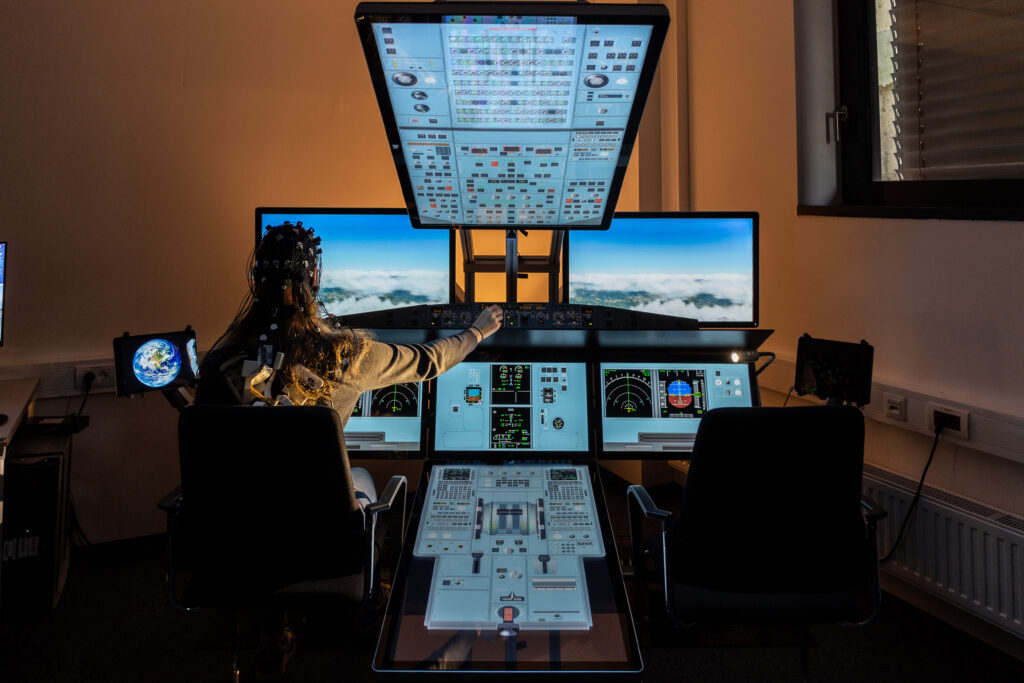
How can we effectively assess mental fatigue in the cockpit? A new comprehensive review by the RESPONSE team, just published in the journal Frontiers in Neuroergonomics, tackles this critical challenge.
The article, titled “The state of the art in assessing mental fatigue in the cockpit using head-worn sensing technology”, examines the potential of physiological monitoring tools for aviation.
Mental fatigue is an important construct for aviation as it can impact pilots’ performance. However, its assessment remains challenging. Most research in this field is based on basic laboratory experiments, and current measurement methods have limits that must be overcome to be applied in a cockpit.
In this review, the paper provides a critical overview of:
- The gap between fundamental research on mental fatigue and its practical application in aviation;
- Classical experimental paradigms used for inducing mental fatigue and subjective measures;
- Advanced head-worn and face-targeted sensing technologies, specifically electroencephalography (EEG), functional near-infrared spectroscopy (fNIRS), and eye-tracking;
- The limitations and open challenges associated with each measure.
Understanding these technological limits is a prerequisite for our work. By identifying the feasibility of integrating these measurements into the cockpit, this paper highlights the specific gaps that future research needs to bridge.



Leave A Comment