As ASTAIR nears the conclusion of its technical phase, the project has intensified efforts to refine its AI-driven concept. Throughout March 2025, three workshops brought together project partners, including the domain experts to advance the project’s technical and operational framework. These sessions focused on automation strategies and human-AI collaboration that were refined within the ASTAIR use cases, and validation methodologies, paving the way for ASTAIR’s final assessment phase.
Workshop #1 – Optimising use cases flows and automation strategies (7 March 2025)
The first workshop, held on 7 March, provided a technical deep dive into ASTAIR’s use cases’ diagram flows. Representatives from Deep Blue, ENAC, Groupe ADP, TuDelft and Eurocontrol examined how different levels of automation impact the operational flows and interactions with key human end users (primarily ATCOs, but also pilots, ground handling, etc.) while ensuring the operational feasibility and acceptability by the end users.
During the session, the team discussed the degree of automation within the concept’s framework and explored improvements to procedural integration, aiming to enhance the interaction between AI-driven processes and human decision-making. Communication strategies between key end users and the AI were a primary focus, as ensuring clarity in high-workload and high complexity airport environments remains critical for operational success.
Additionally, the workshop helped to define steps for the upcoming liability assessment, considering accountability in AI-driven decision-making. Therefore, the clear distinction between the current and new (ASTAIR) operational procedures and levels of automation is a required precursor for a successful liability assessment.
By the end of the session, a clearer understanding of users’ roles and responsibilities had been established, laying the groundwork for upcoming validation activities.
Workshop #2 – Defining human performance metrics and AI teammate usability (20 March 2025)
This second workshop aimed to solidify the assessment framework that will underpin the ASTAIR concept’s evaluation. The discussion focused on defining measurable criteria for human performance, human-AI collaboration, situational awareness, and HMI usability, system functionalities and all critical factors in assessing AI’s operational impact.
Discussions revolved around the structure and effectiveness of assessment methodologies, with a particular emphasis on how best to capture ASTAIR end user’s behaviour during a simulation and other relevant feedback for the final assessment of the concept. The inclusion of a Likert-scale assessment was proposed to provide more detailed qualitative insights into the effectiveness of human-AI interactions. Further refinements were made to the validation objectives and their assessment metrics, ensuring a structured approach to evaluating AI’s contribution to airport ground movements control and management. As a next step, the consortium agreed to develop tailored questionnaires that will be deployed during the upcoming Real-Time Simulation (RTS) validation exercise.
Workshop #3 – Human-machine interaction and automation testing (27 March 2025)
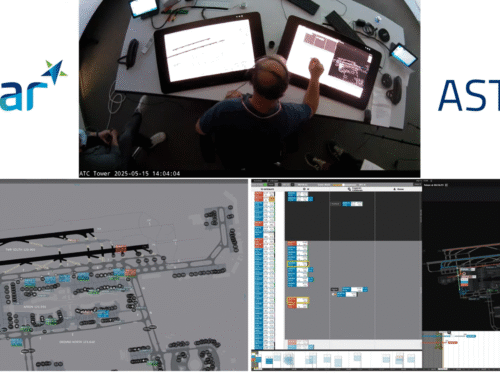
The third workshop provided a practical demonstration of ASTAIR’s Human-Machine Interface (HMI) and automation functionalities. ENAC showcased dynamic interaction designs, illustrating how human operators and the AI system interact within a defined operational scenario including different automation levels. A scenario-based demonstration highlighted the collaborative decision-making process between AI and human controllers, providing crucial insights into usability and operational integration. The session featured a detailed presentation of interaction designs developed for ASTAIR’s interface, demonstrating how different automation levels influence human-AI teaming. Through real-world examples, ENAC illustrated the evolving role of the AI system in assisting air traffic controllers. TU Delft contributed by presenting a scenario from the integration of Multi-Agent System (MAS) on radar screen, offering a first-hand look at how AI-enhanced systems support the users. The discussions that followed focused on usability and acceptability optimisations, with participants identifying refinements such as updates to user’s task completion tracking and interface enhancements to improve operators’ interactions with AI-driven tools.
Next steps: towards final validation
With these three workshops, ASTAIR has consolidated its use cases strategies, enhanced the AI-human collaboration model, and fine-tuned its validation framework. The project now moves towards its final stage of assessment that includes three validation activities: Fast-Time Simulation (MAS assessment) in the coming months, the RTS Validation in a week of 12th of April and lastly, a Final Workshop on the 27th of May 2025. The Final Workshop shall conclude on the findings from the abovementioned workshops and the simulations, and provide the results on the overall ASTAIR’s concept.
By integrating direct stakeholder feedback, ASTAIR continues to refine AI applications that enhance human performance, safety, and operational efficiency in airport operations—ensuring that AI remains a support system, rather than a replacement, for human decision-making in complex air traffic environments.