
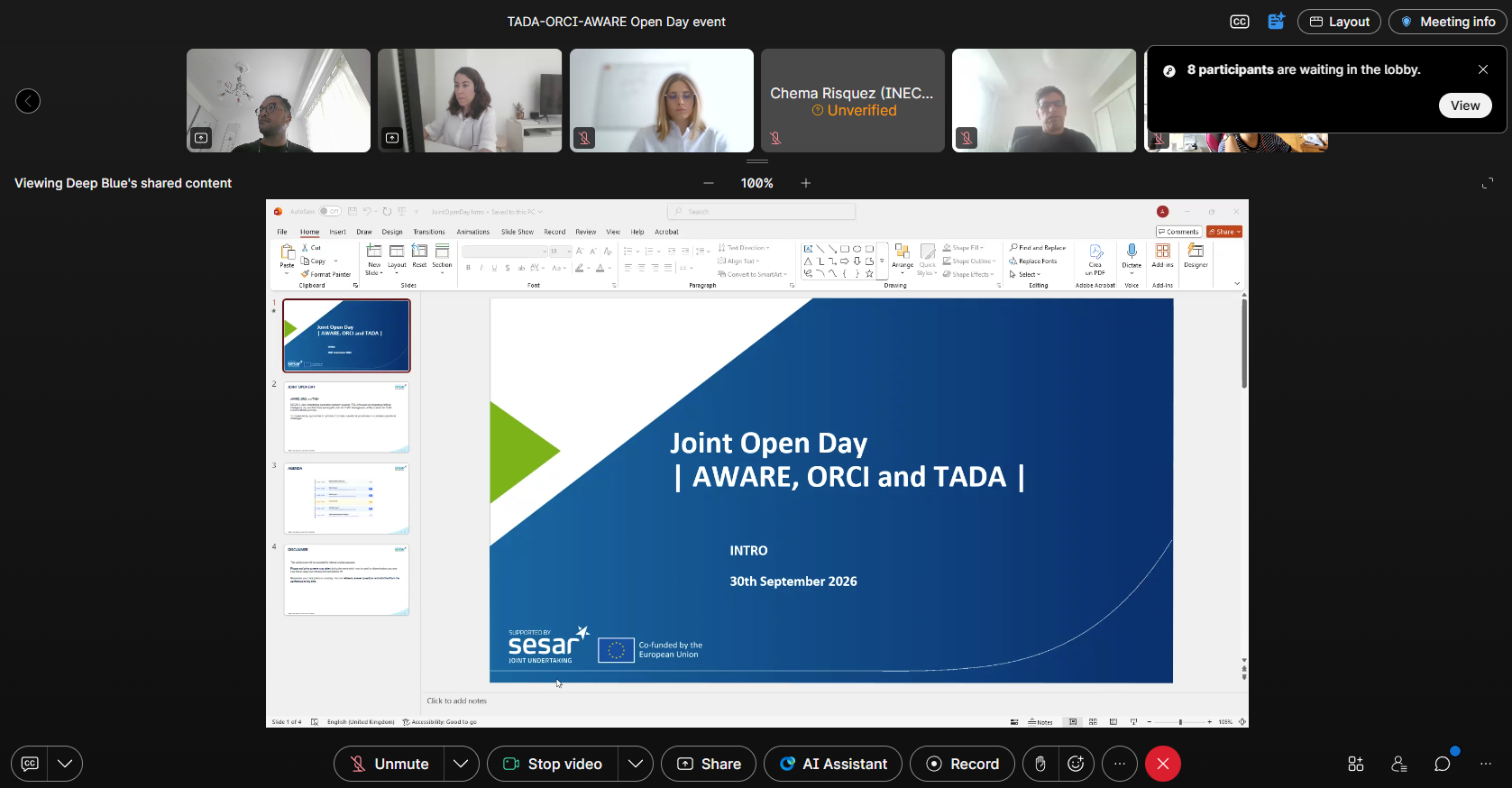
On September 30th, the TADA project joined forces with our SESAR JU sister projects, AWARE and ORCI, to host an online Joint Open Day. Bringing together aviation professionals, researchers, and active Air Traffic Controllers (ATCOs), the event showcased the progress of Artificial Intelligence and automation in Air Traffic Management. During the event, the interactive panel and live demonstrations highlighted a shared vision: AI purpose is to empower human controllers, supporting the mitigation of cognitive overload in increasingly complex airspaces.
A 360° View of the Flight Profile
In fact, the strength of this joint event was the opportunity to present a complete, sequential look at how AI supports operations across the entire flight path.
-
AWARE (En-route): Validated in Malmö ATC, AWARE focuses on the en-route phase by developing an enhanced Artificial Situational Awareness (ASA) system. By integrating knowledge-graph reasoning and Machine Learning, the system assesses ATCO goals and suggests support actions while ensuring the controller retains ultimate control.
-
TADA (Terminal Manoeuvring Area): Focused on the Milano TMA (Malpensa and Bergamo), TADA provides a digital assistant that translates AMAN sequences into separated, proposed 4D trajectories (4DPT), giving controllers a clear indication of distance-to-go and decision-making support.
-
ORCI (Final Approach): Handling the critical final approach phase, ORCI utilises an AI-based Decision Support Tool (DST) to predict spacing between consecutive aircraft at the localiser interception point. Specifically, this concept has been successfully validated in Barcelona and Lisbon to improve arrival spacing predictability.
The TADA Solution in the Terminal Airspace
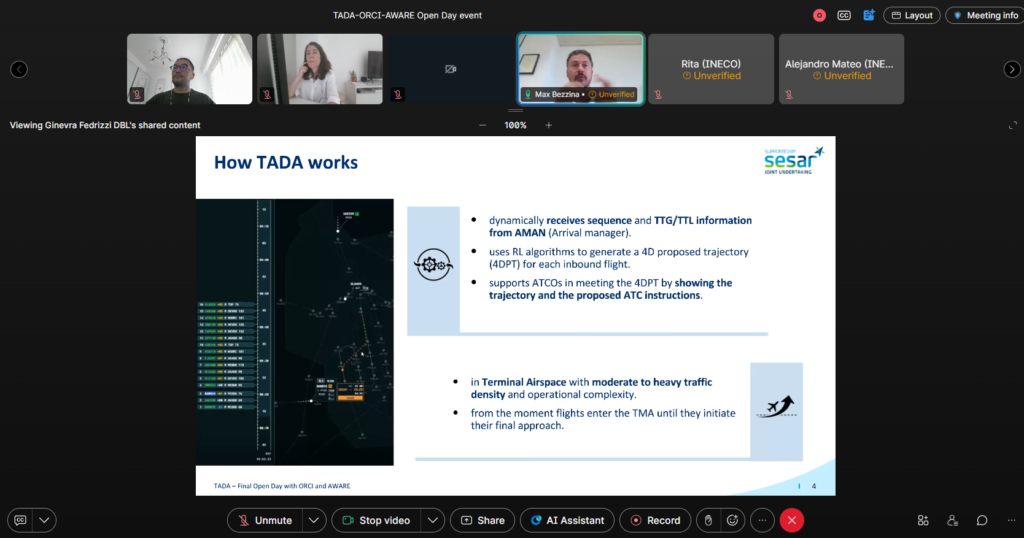
Within this broader ATM ecosystem, TADA tackles the tactical challenges of a busy Terminal Manoeuvring Area. To achieve this, TADA leverages a multi-agent Reinforcement Learning (RL) architecture. This advanced system learns to issue discrete operational clearances to individual aircraft, which preserves necessary separation, reduces schedule deviation, and limits unnecessary controller interventions.
Ultimately, TADA aims to deliver an intelligent Digital Assistant and an optimised Human-Machine Interface (HMI) that supports ATCO decision-making and reduces workload. At the same time, the TADA solution will improve airspace capacity, enhancing safety, and enabling more efficient flight trajectories.
Key Takeaways from the Joint Panel
The panel discussion highlighted practical insights regarding the operational deployment of Human-AI teaming in aviation. Below, some of the key takeaways from the joint Open Day panel discussion.
-
AI as a Safety Net: Automated tools come in handy for monitoring probabilistic events (like conflict detection) and reliably performing monotonous tasks, acting as a robust additional safety layer for controllers.
-
Retaining Human Authority: Across all three projects, a central tenet remains clear: whether using linear regression models, multi-agent reinforcement learning, or knowledge graphs, the technology is designed to support decision-making while explicitly retaining ATCO control.
-
Sustainability and Efficiency: Smarter automation directly supports environmental sustainability by optimizing resource usage and reducing unnecessary emissions, all while driving up overall sector capacity.
Access the Event Materials
Did you miss the live session or want to revisit a specific technical demonstration? The Open Day presentation slide decks from TADA, AWARE, and ORCI will be available here shortly! So, don’t miss out on the joint Open Day materials and check the TADA News page to keep updated.
- TADA Project presentation
- AWARE Project presentation
- ORCI Project presentation


Leave A Comment