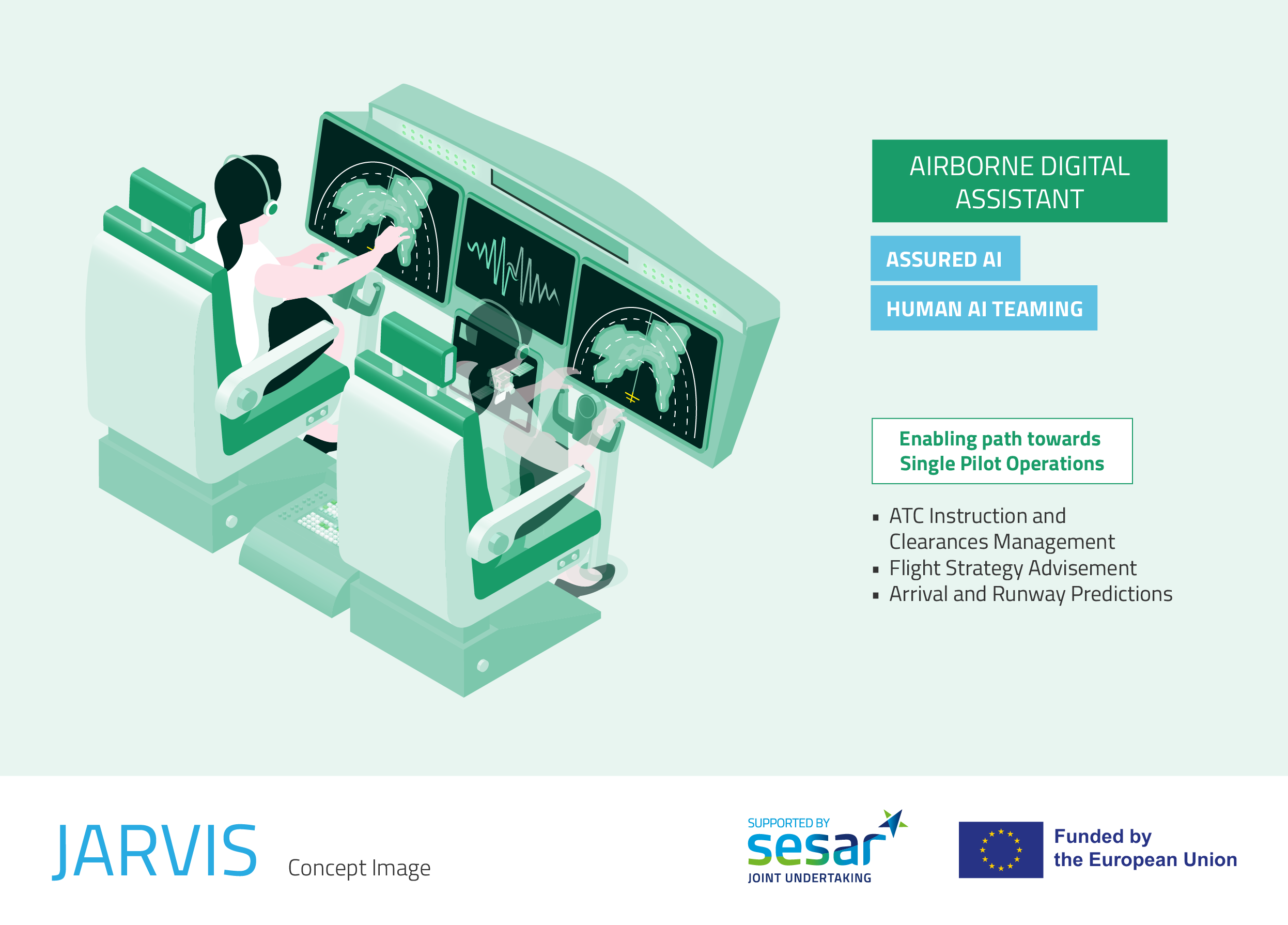
JARVIS (Just a Rather Very Intelligent System) is an EU-funded project focused on developing three artificial intelligence-based digital assistants (DAs) designed to work alongside human counterparts to ensure safer and more efficient operations in air traffic management (ATM).
The Air Traffic Control DA (ATC-DA) is designed to assist controllers across various operations. One of the key features developed in this context is the Conflict Resolution Advisor (CORA). This tool is currently undergoing validation by ENAC and ENAV, with completion scheduled for the end of February 2026.
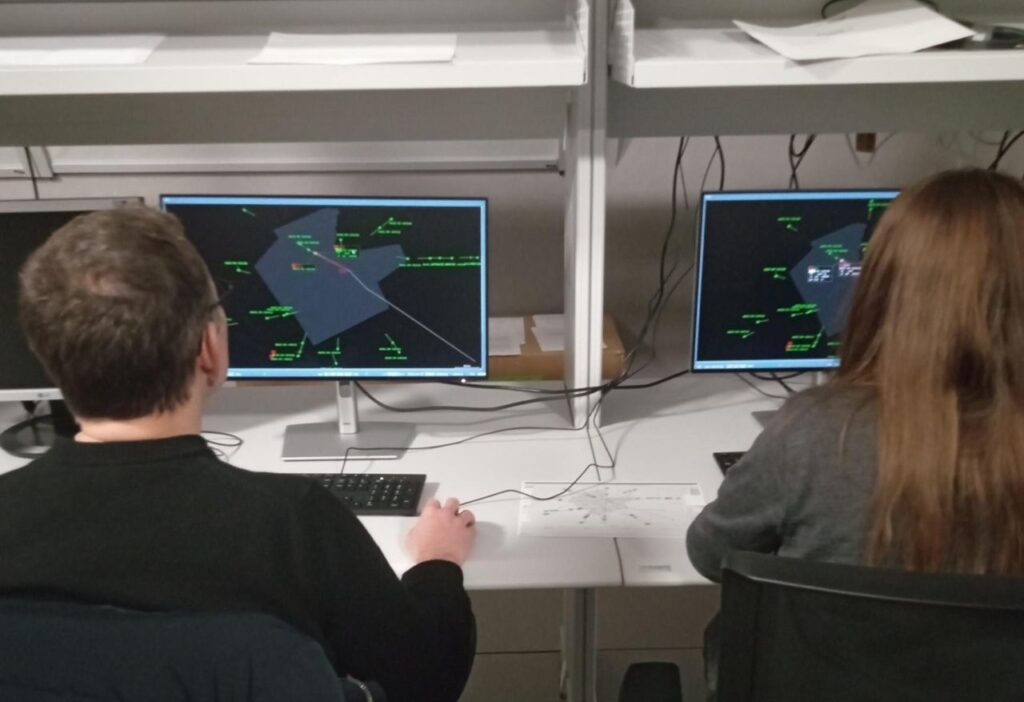
In March 2025, the Ecole Nationale de l’Aviation Civile (ENAC) executed and led the first validation, providing air traffic management expertise, the validation protocol and analysis, and the human resources (ATCOs) for the data collection and the exercise itself. Airbus DS, supported the validation by providing the simulation environment, including the component under test: the ATC-DA CORA (Conflict Resolution Assistant).
Inside the simulation: testing CORA
In this exercise, ENAC and Airbus DS developed an AI algorithm designed to propose conflict resolutions during the tactical phase, moving from EASA automation level 1B towards 2A.
Upon detecting a conflict between flights, the feature proposes a set of up to three resolution options. These options are ranked by the AI component based on ATCO preferences, having been trained on historical controller data. The simulation relied on the TESLA prototype developed by Airbus DS. The architecture consisted of a stand-alone platform fed by an external simulation engine, working in conjunction with a pseudo-pilot module named GENETICS.
The systems developed by Airbus DS included:
• TESLA: Main component implementing advanced ground services.
• GENETICS: Flexible and modular system used to generate air traffic situations.
• DALIA: The Human-Machine Interface (HMI) and Controller Working Position (CWP) used to demonstrate TESLA services.
Nine scenarios have been used for the validation runs, from medium to very high density in en-route virtual sectors. To prevent familiarity bias, these sectors were designed specifically for the simulation and do not exist in real life.
Innovation meets reality
The results confirm the significant potential of an ATC-DA, demonstrating that concerns raised by end-users can be actively addressed to guide the safe development and deployment of such tools. To ensure a robust assessment, the results of this validation will be compared with ENAV’s, and carefully extrapolated taking into account the experiment’s context.
The exercise demonstrated that the ATC-DA CORA feature is well perceived by air traffic controllers and represents a promising support tool worth further exploration. Its potential lies in complementing human expertise, provided it is introduced gradually to gain trust from ATCOs and used with proper safeguards.
The tool should be viewed as an aid to decision-making rather than a means to push capacity limits: preserving the controllers’ situation awareness remains the key priority.
Analysis of the validation results suggests that the current EASA automation level 1B is adequate for the short-term horizon. The AI algorithm was recognized as a valuable technology, especially for post-analysis activities aimed at improving conflict detection and resolution knowledge.
For now, its role in live operations is best seen as supportive and advisory. This approach provides time to further establish the trust, experience, and training necessary for its safe and effective integration alongside human operators.
—
The Ecole Nationale de l’Aviation Civile (ENAC), leading the first validation exercise, is a public institution under the supervision of the French Ministry of transport. ENAC provides ab-initio and continuing education for the executives and main players of the civil aviation world.
Airbus Defence and Space is a subsidiary of Airbus that proposes innovative space and defence solutions and services.