
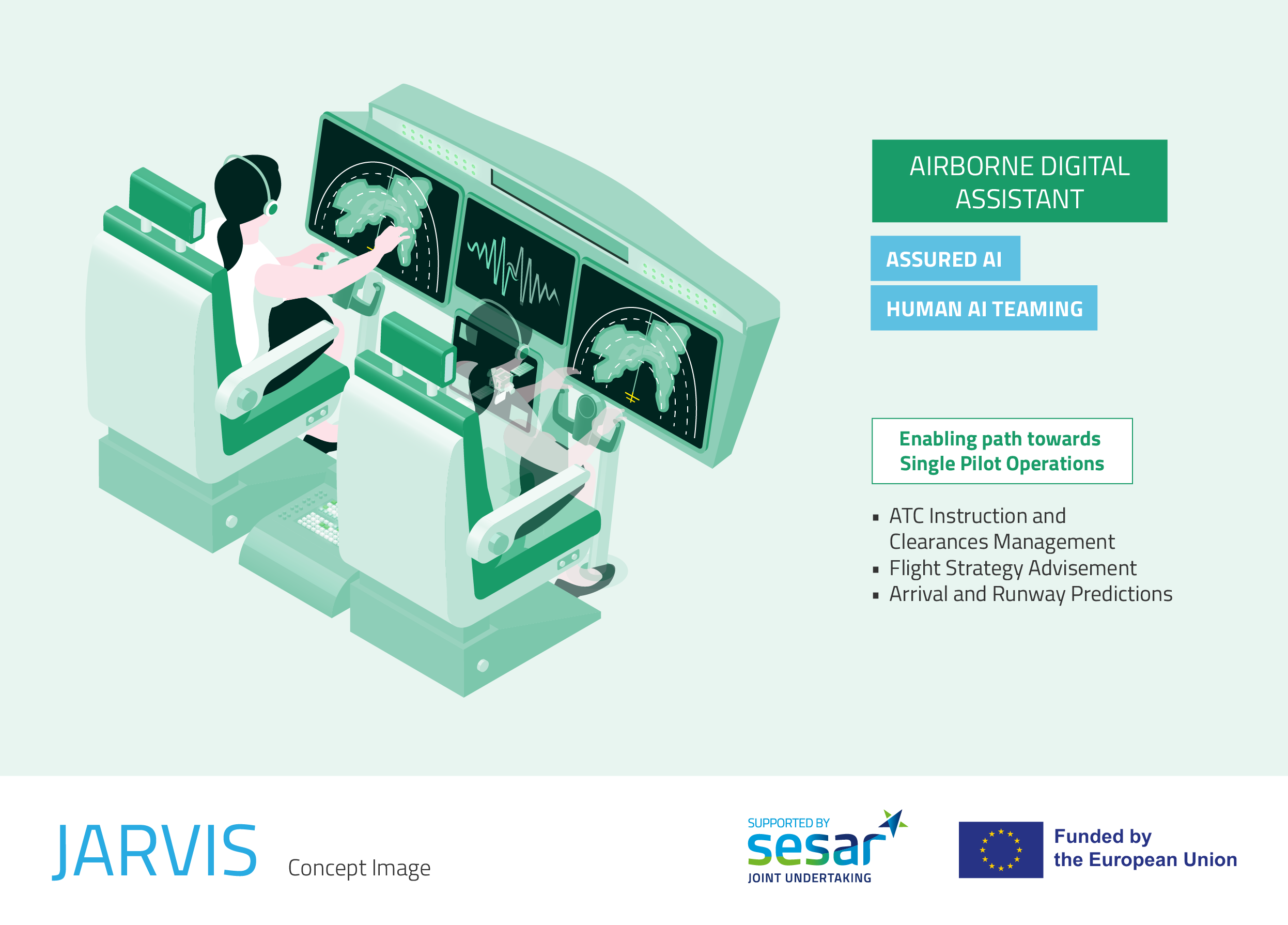
JARVIS (Just a Rather Very Intelligent System) is an EU-funded project focused on developing three Artificial Intelligence-based digital assistants (DAs) designed to team up with human operators for safer and more efficient air traffic management.
Among these, the Airborne Digital Assistant (AIR-DA) aims to revolutionize the flight deck by enhancing situation awareness and reducing pilot workload across all flight phases, from planning to emergency management.
On 30 October 2025 the human-in-the-loop validation campaign led by the German Aerospace Center (DLR) finalised. The results will soon be released, providing an insight into the potential of the AIR-DA as a collaborative tool in the cockpit.
Three AI features to support flight operations
JARVIS’ AIR-DA is a newly developed AI-based assistant for the cockpit that will assist pilots throughout the course of the flight.
It comprises three AI-based different features.
● ATC Instruction and Clearance Management (developed by Collins Aerospace)
● Flight Strategy Advisement (developed by Collins Aerospace)
● Arrival and Runway Predictions (developed by Boeing)
Through a combination of speech recognition, machine learning, and machine reasoning, these features support pilots in crucial tasks: communicating with Air Traffic Control, decision-making during cruise (e.g., weather avoidance or system failure management), and optimizing approach planning. All features were successfully integrated into the DLR validation environment for testing with operational experts.

Inside the simulation: pilot-in-the-loop
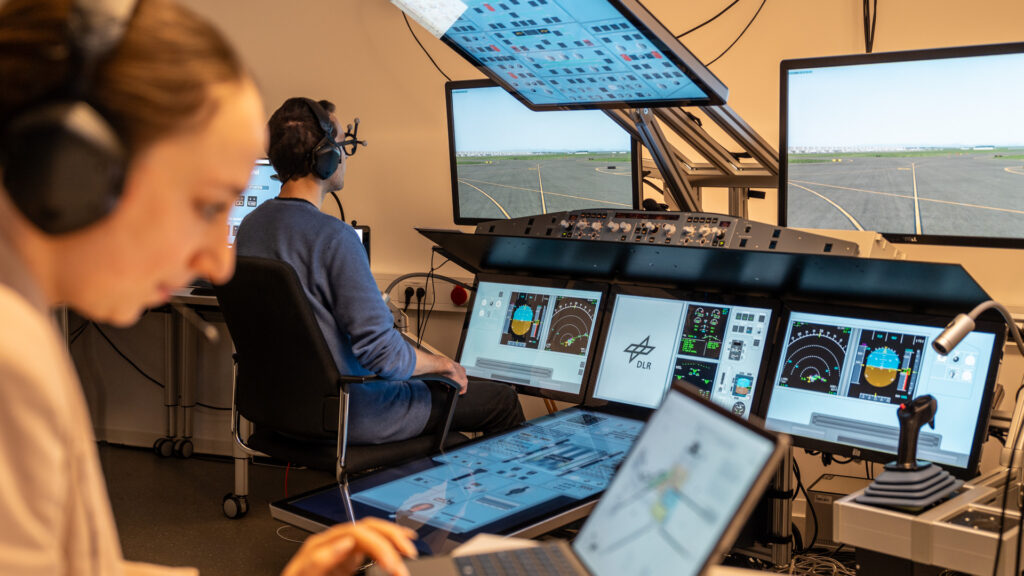
The validation trials involved 21 experienced commercial pilots from European airlines, comprising 6 captains and 15 first officers. DLR conducted the human-in-the-loop real time simulation with a focus on human performance, including assessing AIR-DA’s influence on mental workload, situation awareness, decision-making, perceived usability and its impact on safety. This approach provided a comprehensive picture of how the system contributes to pilot tasks, highlighting both strengths and current limitations.
Operational experts conducted simulated flights using the iSIM simulator at the Institute of Flight Guidance at DLR Braunschweig. The iSIM is a configurable flat-panel simulator combining touch input and hardware components. For the validation trials, AIR-DA was fully interfaced with the simulator, utilising live flight data (e.g. position, altitude, flight plan changes) to provide real-time assistance based on the pilot’s actions.
Data gathered from eye-tracking and debriefing sessions is currently being analysed to fully assess AIR-DA’s performance, and thus the potential of AI-based assistance in the cockpit.
Refining the technology to shape the future of Human-AI Teaming
The results will be published in the coming months, and will offer a tangible breakdown of the system’s benefits and strengths, significantly contributing to its maturation. By leveraging this expert feedback, the project ensures that future developments remain user-centric, specifically identifying which features already deliver value and pinpointing areas for refinement.
By letting operational experts test the DAs, the JARVIS project had the unique opportunity to understand if and how this new technology can contribute to a safer, more resilient European aviation.
Such a way of “testing the waters” can help to understand how AI can contribute to the aircraft of the future. By targeting relevant topics like trust and situation awareness, DLR’s results will provide valuable “lessons learned” for the broader challenge of Human-AI teaming.
About DLR
The German Aerospace Center (Deutsches Zentrum für Luft- und Raumfahrt; DLR) is Germany’s national research and technology centre for aeronautics, space, energy, transport, security and defence. DLR’s work spans a wide range of applications, delivering results and innovations that benefit industry and business, government agencies and the public sector. At the heart of DLR’s mission is its commitment to society, which it fulfils through extensive knowledge sharing and targeted technology transfer. Therefor it is funded through federal resources. The German Space Agency at DLR is responsible for planning and implementing German space activities on behalf of the federal government. Additionally, two project management agencies at DLR manage research and industrial funding programmes.
Within DLR, the Institute of Flight Guidance works on future processes for integrated airborne and ground-based guidance. This includes optimizing airspace use and airport throughput while minimizing environmental impact.
Photo credits: © DLR. Alle Rechte vorbehalten.


