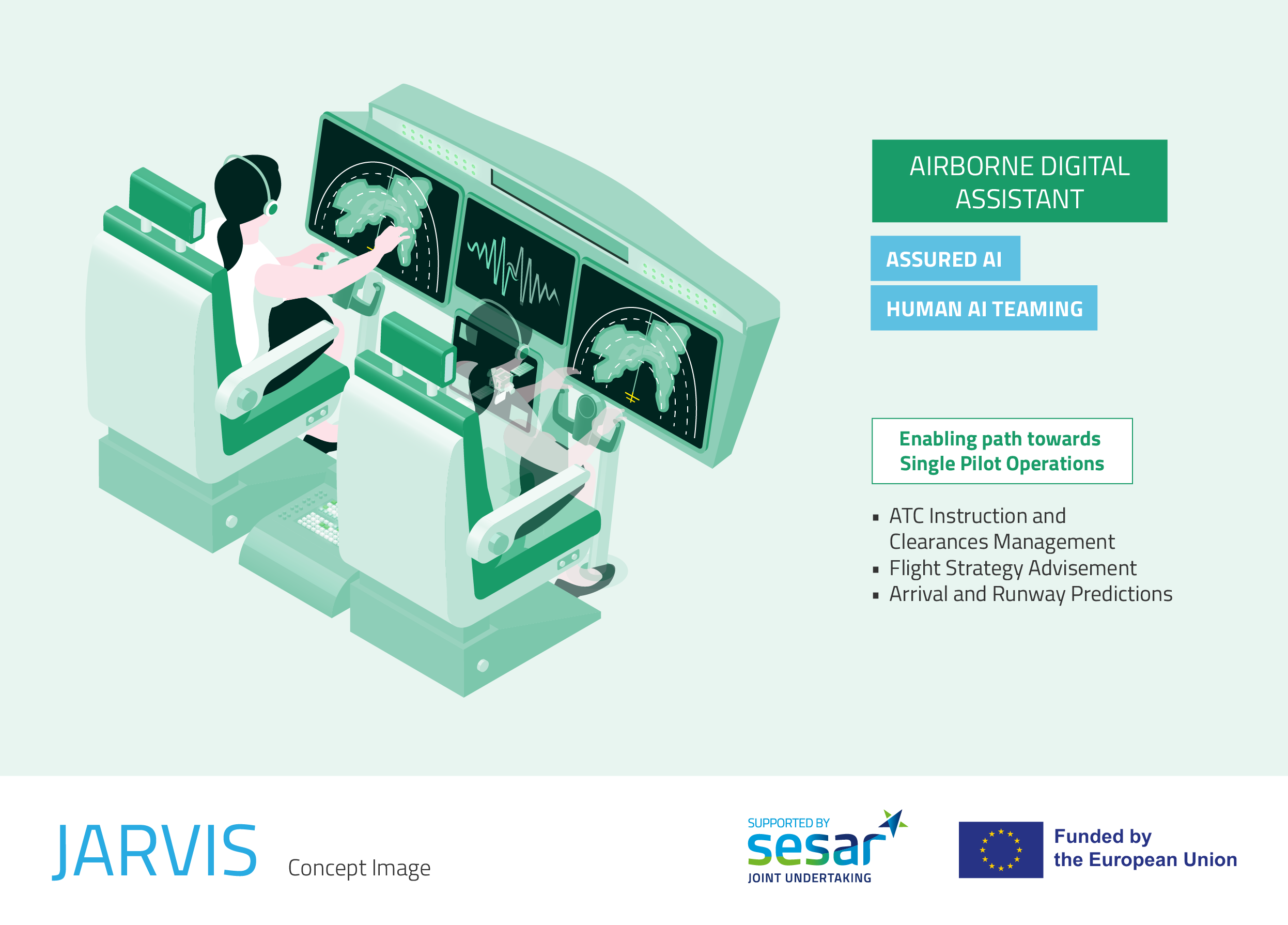
From September 2023 to May 2026 the JARVIS project developed three AI-based digital assistants to team with pilots, air traffic controllers and airport operators to ensure safer and more efficient operations. During these three years, prototyping, developing and validating the assistants lead to several lessons learned on foundational AI challenges, that are now part of three newly released public whitepapers, publicly available for AI developers and everyone to consult.
The JARVIS whitepapers on AI challenges communicate knowledge and lessons learned created within JARVIS beyond the projects’ consortium by means of three separate whitepapers. They summarise findings with regards to Data Gathering, Assured AI Design and Human-AI-Teaming (HAT). Furthermore, interplay of ethics and designing AI-based assistants for aviation have been examined within the project and a summary is provided here.
The whitepapers were produced under the guidance of DLR and in partnership with NLR, CIRA, Deep Blue, Collins Aerospace and ENAC, in collaboration with EASA.
The whitepapers aim to contribute to AI development within the domain of Air Traffic Managements (ATM) and to the conduction of AI technology focused projects within the SESAR framework. The intended readership of the whitepapers is the AI development community in general, with a focus on system developers, project managers and academics. Therefore, the level of detail with regards to the specific JARVIS ATM solutions was kept low, and general learnings and recommendations were derived. Readers interested in more specific information on the JARVIS solutions can consult JARVIS scientific publications.
You can find them available in Zenodo:
– AI Assurance Whitepaper
– Dataset Creation Whitepaper
– Human-AI Teaming Whitepaper
JARVIS has demonstrated that the long-standing predominance of manual radio-based ATM can be revolutionised through digital transformation. By directly embedding AI-based digital assistants into the workflow, the project proved that AI-methods are not only theoretically but also operationally feasible.
During the project a range of core technologies was successfully tested in all operational areas: Speech‑to‑Text for capturing ATC‑pilot exchanges, machine‑learning models for airport taxiway‑incursion detection or ATC-conflict resolution assistance, and an automated‑reasoning engine for airborne flight‑strategy advisement. These demonstrations showed that the AI technology can be integrated into existing ATM processes.