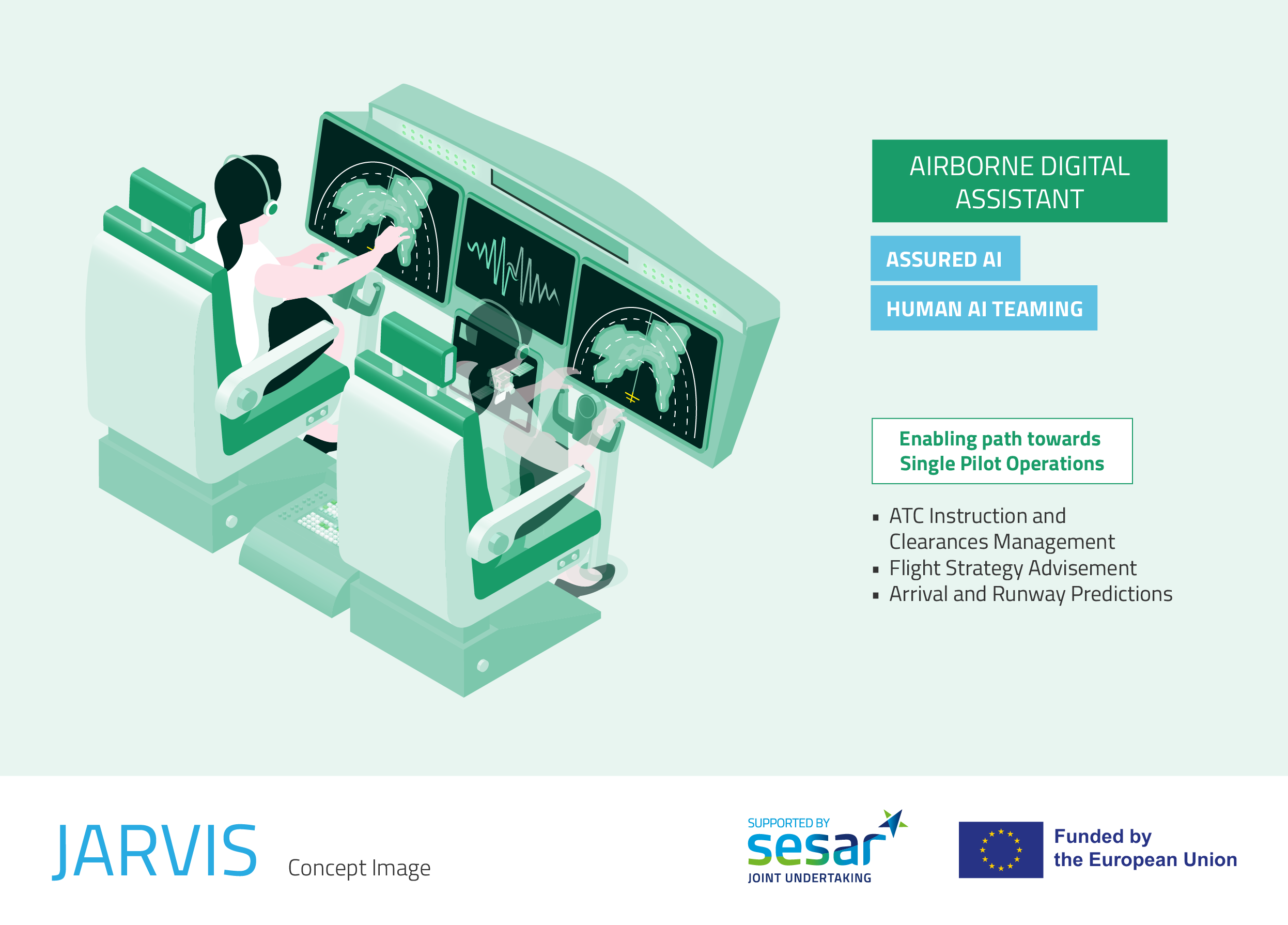
As the aviation ecosystem grows, greater readiness for new and increasingly complex scenarios must be ensured. The EU-funded JARVIS project is prototyping three AI-based digital assistants to team with air traffic controllers (ATCOs) and airport operators and respond to the growing traffic demand and increased complexity.
Several features of these digital assistants have been validated throughout the three years duration of the project, with first results showing the potential of integrating AI-based tools to team with human counterparts.
The Air Traffic Control Digital Assistant (ATC-DA), which will assist ATCOs from the pre-tactical phase to real-time operations, is composed of several features [1]. Indra is developing the Short term Forecaster, that you will read about in this article, the Flight Plan Corrector feature and the Direct Path Recommendation.
The results of this validation underline the strong potential of AI-driven forecasting tools to transform air traffic management.
AI-Powered proactivity: supporting Room Operations Supervisors
The Short Term Forecaster is an AI-powered tool designed to predict traffic across different volume levels. Its primary goal is to support Room Operations Supervisors in making informed decisions when fine-tuning sectorizations within a pre-tactical window. By leveraging advanced algorithms, the tool analyses historical and real-time data to forecast traffic patterns, enabling supervisors to anticipate potential bottlenecks and optimize resource allocation. This predictive capability helps improve operational efficiency, reduce workload imbalances, and maintain safety standards. Ultimately, the feature empowers teams to act proactively rather than reactively, ensuring smoother operations and better service delivery.
Indra is contributing to the validation of the Airport Digital Assistant and on specific features of ATC-DA. In this validation exercise, Indra has developed artificial intelligence solutions to test two key capabilities of the JARVIS ATC-DA: the correction of flight plans, the forecasting of traffic demand and the direct path recommender all evaluated in simulated operational environments using real data.
During the validation activities, Indra led the platform development and overall validation effort. They were supported by ENAIRE, who supplied Room supervisors and Flow Operators (PDV), and CRIDA, who provided essential concept development assistance throughout the exercise.
From prediction to reality: human-in-the-loop validation
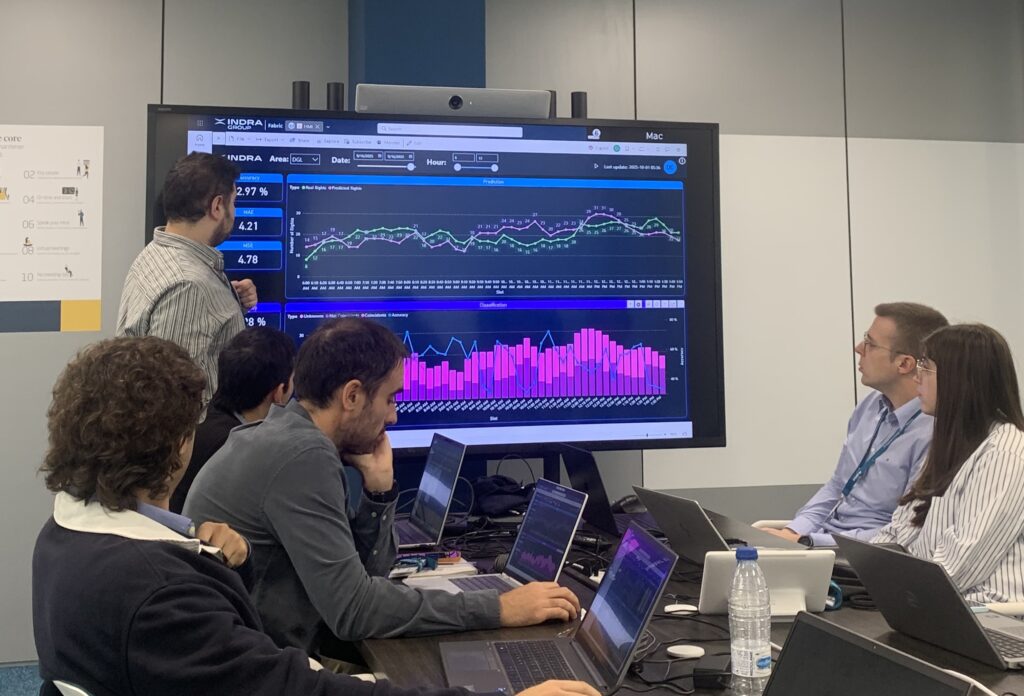
The validation process of the features involved presenting the tool and its capabilities to qualified operational staff, specifically those with experience as Room Operations Supervisors. During the exercise, the tool displayed traffic forecasts for the same day and allowed users to review previous forecasts compared against actual traffic data to assess accuracy. This comparison serves as a trust indicator for the tool’s predictive reliability. Finally, participants provided feedback on operational utility, suggesting potential improvements.
The tool was implemented through an HMI developed in Power BI. This interface displayed forecasted traffic across different traffic volumes for the day, alongside filed flight plans retrieved from the Network Manager business-to-business by EUROCONTROL. This setup allowed users to compare filed flight plans with actual traffic as predicted by the AI algorithms. Additionally, the tool provided access to historical forecasts and their corresponding actual traffic data, enabling accuracy assessment over time. The Power BI interface was significant because it offered an intuitive and interactive environment for operational staff to evaluate the tool’s predictive capabilities and provide meaningful feedback.
A valuable tool
The validation exercise was successful and demonstrated clear operational benefits. The operational experts involved provided positive feedback on the feature’s concept and its potential to support decision-making. Recommendations for improvement included adding information related to regulations for better contextual contrast and refining accuracy metrics to enhance trust in the forecasts. Overall, the results confirmed the tool’s value while identifying areas for further development to maximize its operational utility.
The results validate the concept of applying AI to support ATC activities, confirming its feasibility and operational relevance. This successful validation strengthens confidence in the solution’s approach and provides a foundation for further development. By demonstrating tangible benefits and gathering expert feedback, the exercise ensures that future iterations will be better aligned with operational needs, ultimately contributing to the overall success and adoption of the project.
Contributing to the Digital European Sky
By confirming their operational value and gathering expert feedback, the project sets a solid foundation for continued development and future integration into real environments.
This validation exercise contributes to the wider Digital European Sky by demonstrating how AI-powered predictive tools can enhance strategic decision-making and improve the resilience of the European ATM network. By providing Room Operations Supervisors with earlier and more accurate traffic insights, the feature supports a shift towards data-driven, proactive management of airspace resources — a core ambition of the Digital European Sky vision.
The tool’s ability to anticipate traffic patterns, highlight potential bottlenecks, and inform sectorization decisions illustrates how digitalisation can optimise capacity, improve workload balance, and ultimately contribute to a more efficient and sustainable network.
—
About INDRA: Indra is a global leader in air traffic control, communications, navigation, surveillance, and aeronautical information solutions. It works hand in hand with air navigation service providers (ANSPs) and other industry stakeholders to guide the sector toward a more efficient, safe, and sustainable sky.
About ENAIRE: ENAIRE is the primary provider of air navigation and aeronautical information services in Spain, ranking fourth in Europe by traffic volume. As a state-owned company under the Ministry for Transport and Sustainable Mobility, it manages Spanish airspace covering 2,190,000 square kilometres. ENAIRE’s operations handle over 250 million passengers annually on 2 million flights, utilizing five control centres, 21 towers, and a network of facilities with a staff of more than 4000 professionals. It provides en route and approach air traffic services, aerodrome control services in 21 airports, and essential flight information, alert, and guidance services.
About CRIDA: CRIDA A.I.E. is a non-profit economic interest grouping established by ENAIRE, the Polytechnic University of Madrid (UPM), and Ingeniería y Economía del Transporte, S.A. (INECO).
CRIDA’s mission is to improve the efficiency and performance of the Spanish air traffic management system through the development of R&D&i ideas and projects that provide quantifiable solutions through system performance indicators, all while considering the Spanish system as an integral part of a global system.
—
[1] Smart ATC support: the JARVIS conflict resolution advisor