Future outlook from the event “AI based innovation in ATM”
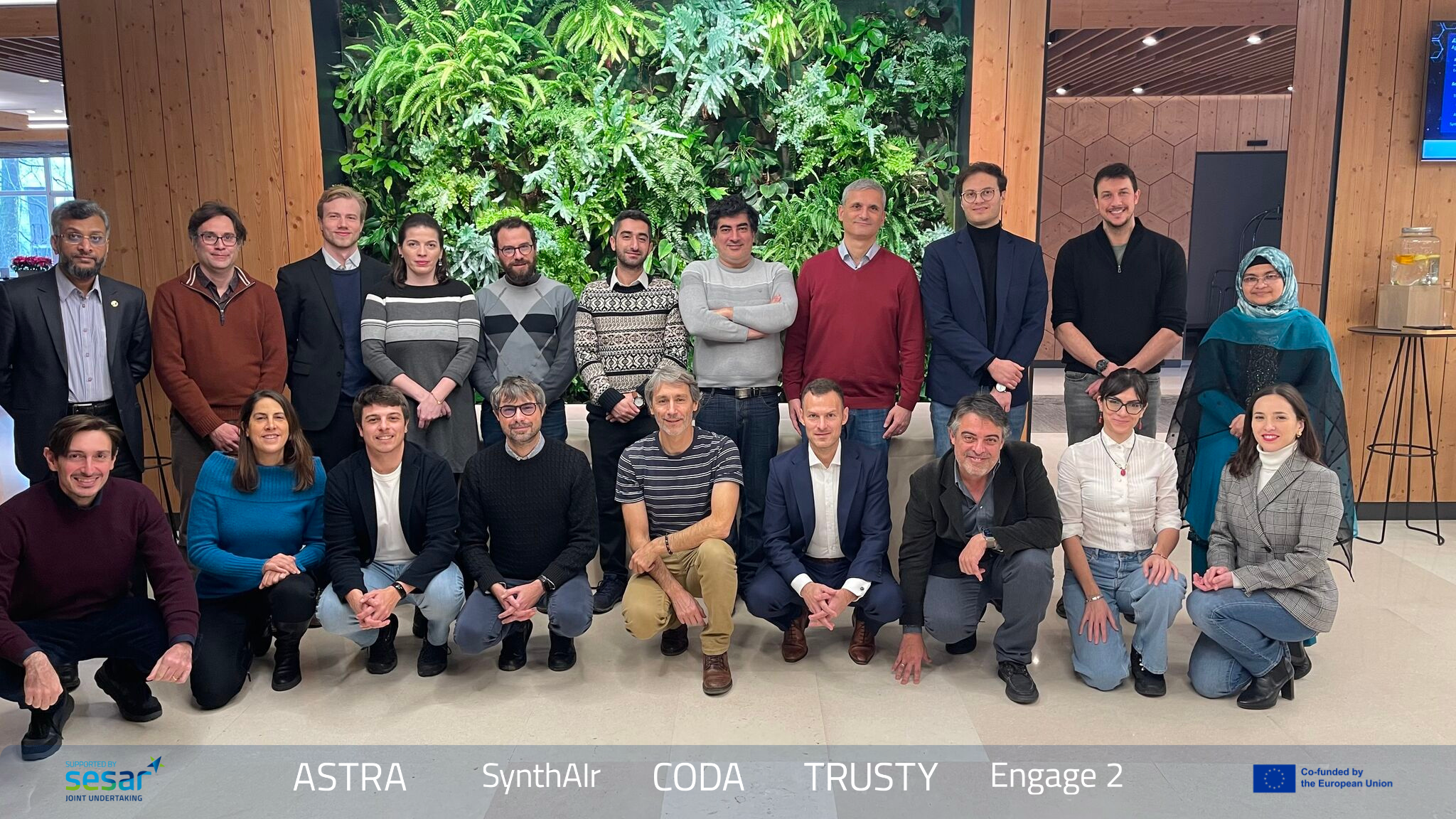
On December 5th, 2025, Bled (along with our online community) hosted a significant gathering for European Air Traffic Management (ATM) research. Bringing together over 60 experts, the event “AI based innovation in ATM: Improving Efficiency, Trust and Safety” brought together four SESAR projects: ASTRA, TRUSTY, SynthAIr and CODA. Driven by the Engage 2 network, the occasion was not just a technical showcase but it was a critical bridge between academia and industry.
The objective was clear: to move beyond the “buzz” of Artificial Intelligence and demonstrate how it can concretely transform ATM while addressing climate impact, system modernisation, and the central role of the human operator.
Project insights and operational realities
During the sessions, key findings that challenge current assumptions about ArtificiaI Intelligence (AI) integration were explored:
- The “Trust Paradox” (TRUSTY Project): When discussing explainability in remote towers, the common assumption is “the more you explain, the more humans trust. However, TRUSTY revealed a critical nuance: higher levels of technical explanation can sometimes decrease user trust, potentially causing cognitive overload or doubt. The future challenge lies in developing precise indicators to measure and calibrate the “correct level” of trust and the appropriate quality of information to be communicated.
- The computation of complexity (ASTRA Project): The project demonstrated how to translate Flow Management Position (FMP) operational expertise into hard data. Using unsupervised machine learning and other techniques, the system clusters aircraft to predict complex air traffic events (“hotspots”) and assigns complexity scores ranging from 0 to 100. By utilizing reinforcement learning to propose resolutions for hotspots, the system aims to reduce the workload of Air Traffic Controllers (ATCOs), with positive qualitative feedback collected during real-time simulations.
- Neuro-adaptive Human-AI Teaming (CODA Project): Moving beyond standard automation, CODA presented an adaptive teaming concept. The system monitors the operator’s state and dynamically adapts its support level in real-time. This approach aims to keep human performance in the optimal zone, ensuring that the machine acts as a true teammate rather than just a tool.
- Data as the Fuel (SynthAIr Project): Addressing the challenge of data scarcity, SynthAIr showed how synthetic data generation is essential for training robust models, ensuring that privacy, data scarcity and quality do not become bottlenecks for innovation.
Key discussion points for the next decade
The final interactive session, featuring experts from Deep Blue and industry partners, identified three main trajectories expected to shape the next 5-10 years of research and implementation:
- The ethical and regulatory frontier: Emphasis was placed on the imperative need for defined ethical guidelines in project development. The primary hurdle for industrialisation is legal: how do we certify an AI system that continues to learn and evolve after deployment? Addressing data quality and ensuring safe integration with legacy systems remain the top priorities for regulators.
- Evolving Training and Roles: The introduction of tools like those seen in CODA and ASTRA is expected to require an evolution in controller training. The Air Traffic Controller (ATCO) of the future is likely to shift from being a tactical executor to a strategic manager of complex systems. AI is expected to support strategic thinking through data analysis and trend identification, while humans will remain essential to interpret and supervise these outputs effectively.
- Cost Efficiency & Sustainability: The long-term goal is to manage increasing traffic complexity and reduce operational costs without compromising safety. The ability to predict hotspots well in advance (strategic vs. tactical) is key to enabling smoother flows. Less fragmented traffic management translates to better flight efficiency and, ultimately, a more sustainable aviation sector.
Moving forward
Engage 2 and these SESAR Exploratory Research projects continue to bridge the gap between academia and industry. By involving universities and research centres, the network helps foster the necessary environment to attract young talent and align research with operational reality.
For those who want to dive deeper into the technical details, use cases, and specific metrics discussed, the official presentations are now available.
📥 [Download the Final Dissemination Event Slides Here]
A special thanks to all the speakers, project partners, and participants who made this exchange of knowledge possible. These projects have received funding from the SESAR 3 Joint Undertaking.


![🎥TRUSTY Voices: Prof. Mobyen Uddin Ahmed Shares the Project’s Vision [Press Play]](https://research.dblue.it/trusty/wp-content/uploads/sites/16/2025/07/TRUSTY-Mobyen-interview-2-500x383.png)